
Dude, Where’s My Bike Parking?
Have you ever arrived at your destination only to spend too much time searching for a secure place to lock your bike? Settling for an insecure signpost? Greater Boston generally hasn’t acted like bike parking is a critical resource to encourage more people to cycle. If you attend a public meeting for a street project, staff will bend over backwards to defend maintaining car parking over increased safety of road users, but won’t even mention where bike parking is, despite it requiring a small fraction of the space.
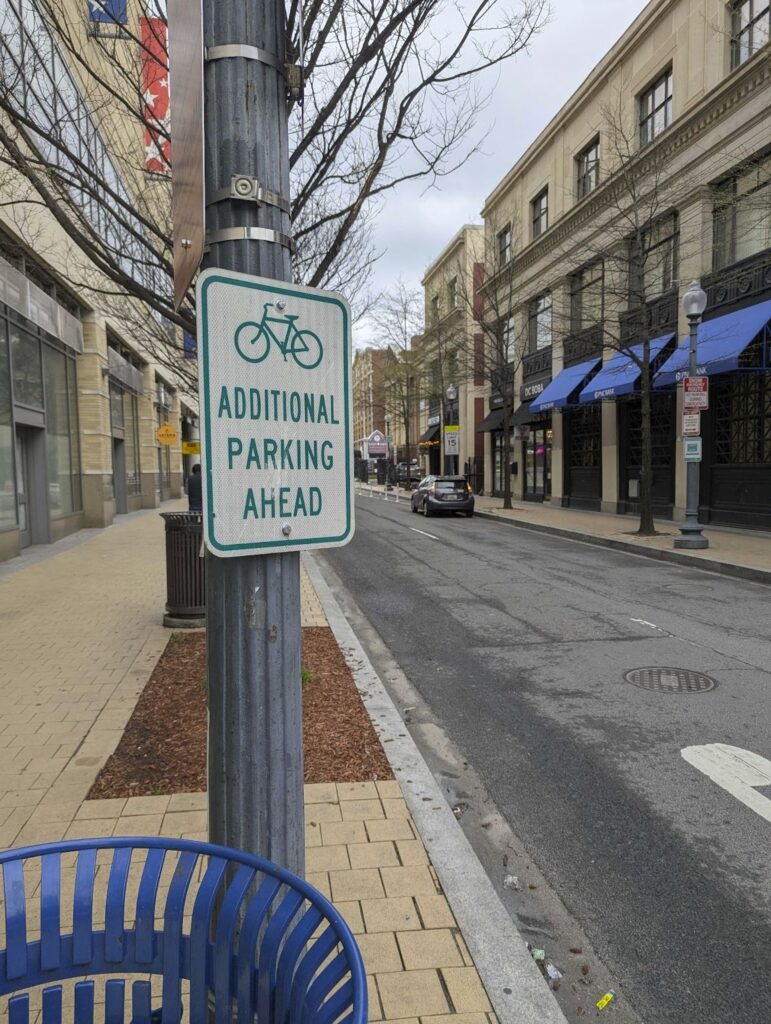
Poor distribution and planning of bike parking is a choice each city makes, and they could choose to prioritize bike parking if they wanted to. The cost to do so is much less in both space and money than the alternative they currently prioritize. Cities like Washington D.C. have chosen a better path, including wayfinding signs for cyclists to find more parking, shown below. Later in this article we dive deeper into the current commitment, or lack thereof, to sufficient bike parking of Boston and a few other cities.
To help elevate this issue and help cyclists know where to find bike parking throughout the region, BCU Labs is excited to publish a dedicated bike parking resource, with a map showing locations of bike parking in Greater Boston, how to request new bike parking, and how to add existing bike parking to our map.
While the USA has 6 parking spots per registered car, we have not built bike parking with the same zeal, despite bike parking costing a tiny fraction of the money and space it takes to provide car parking. The Boston Cyclists Union has previously called out bike parking equity as being a major shortcoming of Boston. MassDOT has recently recognized that our schools don’t have enough bike parking for students and staff, creating the Bike Rack Grant as part of its Safe Routes to School program.
We have collected what cities have published and reached out to city staff to find out how many bike racks different cities in Greater Boston expect to install in a given year. The table below shows how much variation there is between cities, and how much better Cambridge is at actually addressing its bike parking shortfall than everyone else. On our bike parking map that we are releasing today, you can clearly see Cambridge is in a class of its own with respect to having widespread bike parking.
| City | Yearly Bike Rack Installs | New Racks / Per 1000 Residents | New Racks / Sq. Mile | Relative to Cambridge Population | Relative to Cambridge Area |
| Boston (Claimed) | 120 | 0.18 | 2.48 | 14% | 11% |
| Boston (10 Year Actual Average) | 63.1 | 0.09 | 1.31 | 7% | 6% |
| Cambridge | 150 | 1.27 | 23.44 | 100% | 100% |
| Brookline | 25 | 0.40 | 3.68 | 31% | 16% |
| Somerville | 20 | 0.25 | 4.85 | 19% | 21% |
Note: Unless install rates are linked, they were gathered by contacting city staff directly. All these numbers are estimates, and likely optimistic goals by staff. City area and population values from respective Wikipedia pages.
We know there’s not enough parking, but how do we find what’s already there? The Bluebikes system makes it easy to know where you can dock a Bluebike; just open the app and navigate to your destination, and the app will direct you to the nearest station. However, people using personal bikes need to know that there is parking at their destination before they set out. If they don’t, they risk needing to park their bike in a risky way, often on insecure sign posts, creating obstructions for people using wheelchairs, strollers, or other mobility devices.
To help elevate this issue and help cyclists know where to find bike parking throughout the region, BCU Labs is excited to add two new data layers to our Map:
- You can now see where active Bluebike stations are, and clicking on them will show you the current count of bikes, e-bikes, and docks.
- You can also see where bike parking has been mapped. If you click on a rack, you can see more details, including capacity and rack style.
Of note: we believe that bike parking is under-mapped, especially in neighborhoods that have experienced disinvestment over the years, which makes the map less helpful for cyclists and prevents us from performing accurate analyses on parking equity. Help your fellow riders by adding missing bike parking locations with the instructions below the map. There, you’ll also find instructions on how to request more bike parking.
We’re continuing to build mapping tools that help to show where gaps exist in infrastructure, which areas need improvement due to stressful conditions, and more. To get involved with BCU labs, join us here!