
Honoring Dr. Martin Luther King Jr. Through Mobility Justice
By Tiffany Cogell, Interim Executive Director, Boston Cyclists Union
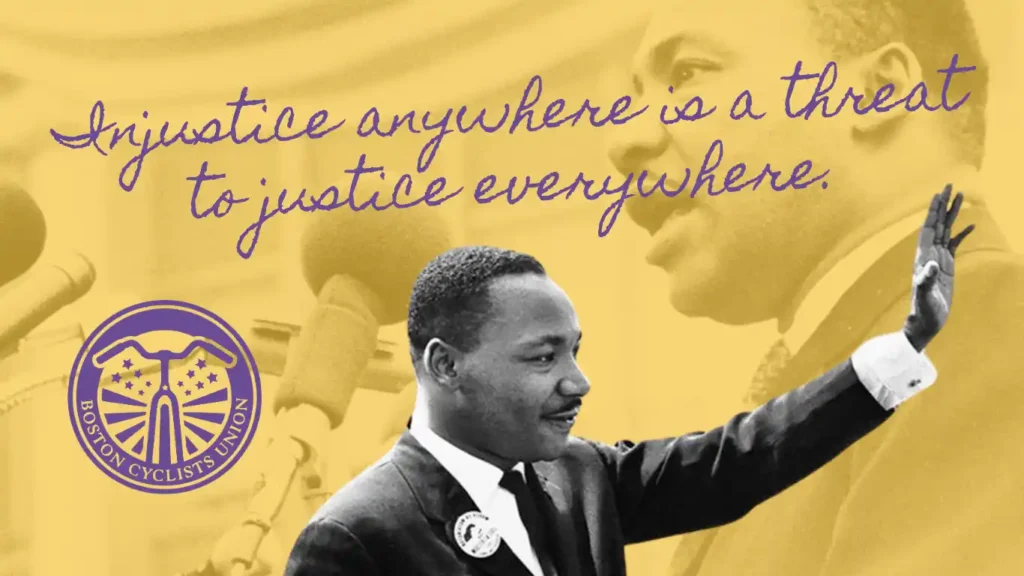
Dr. Martin Luther King Jr. is often remembered for his words, his soaring speeches, his unwavering moral clarity, his call to love and justice. But Dr. King was also a strategist, an organizer, and a disruptor of systems intentionally designed to limit freedom, dignity, and movement for Black people in this country.
Movement matters. Where we can go. How safely we can get there. Whether we are seen, protected, or criminalized simply for existing in public space.
That is where mobility justice lives and why Dr. King’s legacy is deeply connected to the work we do today.
Dr. King fought for fundamental rights: the right to exist without fear, the right to access opportunity, the right to move freely through society without violence or exclusion. These rights did not stop at the ballot box or the lunch counter. They extended into the streets, sidewalks, buses, and neighborhoods where daily life unfolds.
Today, those same rights manifest in our collective right to safe streets.
Yet for far too many people, particularly Black and brown communities, low-income residents, elders, people with disabilities, pedestrians, and cyclists our streets are not safe. Not structurally. Not socially. Not equitably.
Road design prioritizes speed over safety. Enforcement is uneven and too often punitive rather than protective. Infrastructure investments routinely bypass the neighborhoods that need them most. And social norms continue to frame streets as the domain of cars alone, rather than shared public spaces where everyone has a right to travel.
This is not accidental. Dr. King spoke plainly about the difference between equality and equity about the truth that treating everyone the same in an unjust system only preserves injustice. He named the reality that systems were intentionally built to oppress the freedom and liberty of Black people, and that justice requires intentional repair, not neutrality. In the same way, the danger on our streets today is predictable, preventable, and the result of deliberate choices, policy choices, funding choices, and value choices.
Here in Boston, the recent halt in Safe Streets improvements is not merely a bureaucratic delay, it is an affront to our collective freedom and safety. When proven safety measures are paused or abandoned, the consequences are not abstract – they are felt in lives lost, families changed forever, and communities forced to navigate streets that fail to protect them. Accepting stalled progress is, in effect, accepting preventable harm as inevitable, and that is unacceptable.
Mobility justice demands more of us.
It asks us to imagine and insist upon streets where a child can bike to school safely, where an elder can cross the street without fear, where a delivery worker, a bus rider, a wheelchair user, and a cyclist are all treated as equally deserving of protection and dignity. It asks us to demand infrastructure rooted in care for human life, not convenience for speed.
Safer streets do not happen by accident. They require political will. They require accountability. And they require people willing to speak up, even when it is uncomfortable, and to push forward when momentum stalls.
Taking up space on the road is not an act of defiance, it is an affirmation of our right to exist. Pedestrians and cyclists have the right to travel on our roads. Full stop. When we walk, bike, roll, or ride transit, we are participating in public life. We are exercising a freedom that should never come with the risk of injury or death.
On this Martin Luther King Jr. Day, honoring Dr. King’s legacy means more than reflection,it demands action. It calls on us to use our voices to advocate for all vulnerable road users, to demand the necessary changes that protect human life, and to refuse complacency when safety is treated as optional.
Dr. King’s memory and legacy continue as a guiding light for activism rooted in justice, dignity, and collective liberation. Let Dr. King’s courage remind us that change is never comfortable but it is always necessary. Let his memory motivate us to organize, to advocate, and to hold systems accountable so that real, lasting change can take root.
May we honor Dr. King not just in word, but in action. Let us demand safer streets. Let us take up space. And let us build a city and a future where freedom of movement truly belongs to us all.