
Statement Update: Honoring the Life Lost in the August 6 Collision
Updated August 21, 2025
The Boston Cyclists Union extends our deepest condolences to the family and loved ones of the pedestrian who was struck by an e-bike near Copley Square on August 6, 2025, and who tragically passed away the following day. We are heartbroken to learn of this loss and hold the family in our thoughts during this incredibly difficult time.
Traffic violence in all its forms, whether involving cars, bikes, or other modes of transportation, has devastating consequences. No one should lose their life while moving through our city, and no family should have to endure such grief.
As we reflect on this tragedy, we remain committed to advocating for safer streets for everyone, especially people walking, biking, and riding. This means investing in infrastructure and policies that prevent collisions, reduce harm, and prioritize human life above all else.
We will continue to call for solutions that protect all vulnerable road users so that one day, no other family will experience the loss this family has suffered.
Original Statement: We need safe streets, not bike regulation after tragedies
Posted August 11, 2025
On August 6th there was a crash involving a delivery worker on an e-bike and a pedestrian, in the area of Dartmouth and Huntington near Copley Square where safety infrastructure installation was halted. We sincerely wish a full and swift recovery for all involved. Our thoughts are with them and their families during this difficult time.
There were two other serious crashes around the same time. One on August 6th, involving a scooter rider at Humboldt Avenue and Seaver Street, and another in South Boston on August 2nd in which a person on a bike was struck by a car. Both crashes underscore the urgent need to address dangerous conditions for micromobility users throughout Boston.
However, we should not fall into the trap of stoking fear about e-bikes, scooters, and delivery workers, calling for registration and insurance, instead of tackling the root cause of unsafe street design and the far greater threat of fast, oversized motor vehicles.
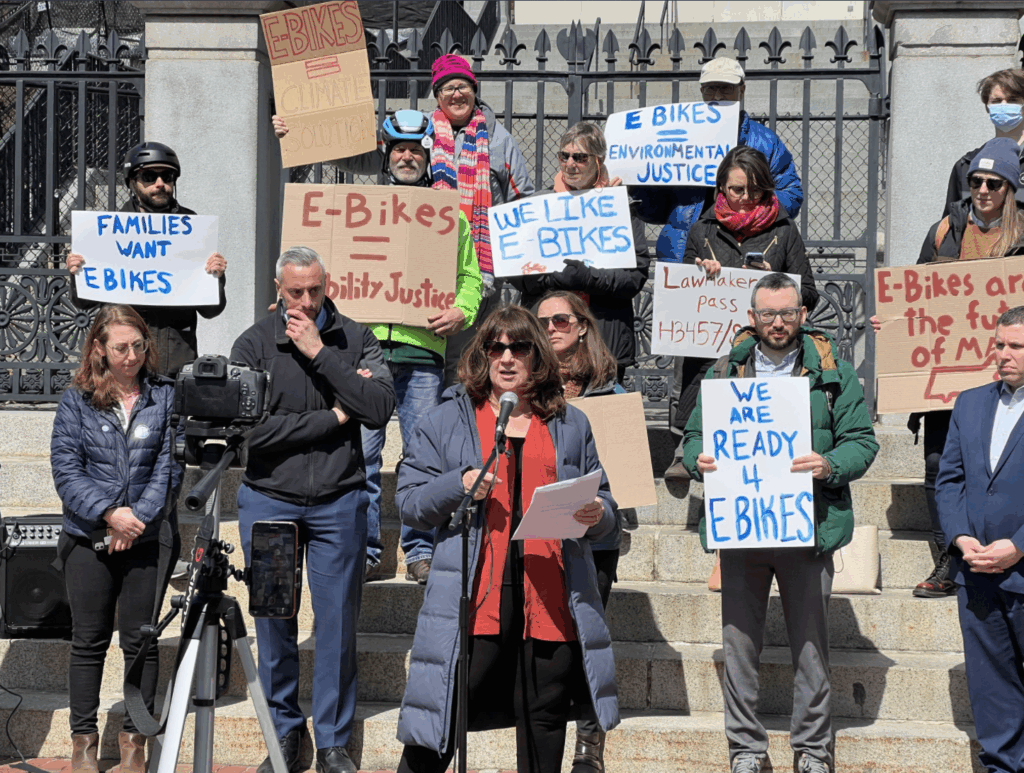
E-bikes are a critical mobility tool for those who cannot afford cars. Many e-bike riders are under-employed riders, people of color, immigrants, and delivery workers. Alternative transit in any form improves pedestrian safety by replacing cars, which are far more dangerous. Unfortunately stories of pedestrians being hit by bikes and ebikes are sensationalized, they are extremely rare in comparison with occurrences of pedestrians being injured by cars and trucks.
Had the delivery worker been operating a car, this crash would very likely have been fatal. Every day in this country, people driving cars injure and kill pedestrians, cyclists, and other motorists at alarming rates, yet those incidents rarely receive the same level of media scrutiny or public outrage. It is important to clarify that the e-bike involved belongs to an already regulated class of e-bikes, a key fact that gets lost in these narratives which cause “bikelash”.
Both incidents happened at wide, fast, and unprotected intersections, places known to be dangerous and hostile to people walking, biking, or working in the public right-of-way. These are design failures before they are personal ones. It is unacceptable that we continue to tolerate intersections where crashes are predictable and inevitable. Blaming the victims of these crashes moves us away from the real cause, and pushes us further from a Vision Zero future.
Delivery drivers, many of whom are immigrants and working-class residents, are under immense pressure to deliver faster and work longer hours for low pay. Demonizing them for trying to do their jobs under strict time constraints is not only unjust, it’s also a distraction from the urgent conversation we need to be having: how do we build streets that prioritize human life over speed?
Let’s also remember: these were not “accidents.” Crashes are the predictable result of policy choices, street design, and enforcement priorities. And while the public often calls for tighter regulations on bikes and e-bikes when crashes occur, the same urgency is rarely applied to motor vehicles. Where is the urgency for cars to come equipped with built-in speed regulators?
We need structural, system-level solutions that match the scale of the problem and address the engineering, enforcement, and policy gaps that make Boston’s streets unsafe.
- Ban Right on Red in Boston
- Cities that prioritize the safety of pedestrians reduce conflicts in intersections. Impatient drivers glancing only for oncoming traffic, and not children, slower crossing elders, and people on bikes risk all of our lives and limit mobility. Cambridge recently banned right on red, following a national trend. It’s time for Boston to follow suit.
- Improve Police Crash Reports for Accuracy and Transparency
- Police reports are often repeated verbatim by the media, perpetuating passive voice and “accident” focused language. By making police crash reports more fact based, that will influence press reporting. These reports will inform the public more accurately, identifying drivers and not cars as the agent responsible for crashes, and not using value based language such as “accident” which implies inevitability.
- Adopt a Formal Crash Analysis Framework
- A timely public report is created with an analysis of what factors led to the crash including road design, vehicle size and blind spots, lack of enforcement, etc.
- The report should be standardized and able to be easily aggregated for research and analysis purposes
- The report contains input from advocacy and neighborhood groups and allow for public comment
- Mitigations are noted in the report as to how future crashes could be prevented, including short, medium, and longer term improvements
- A yearly public summary report is produced that summarizes the root causes of crashes in Boston, what progress has been made, and what is left to do
Tiffany Cogell, Interim Executive Director
Boston Cyclists Union
Advocating for safe, equitable, people-first streets across Greater Boston